TL;DR
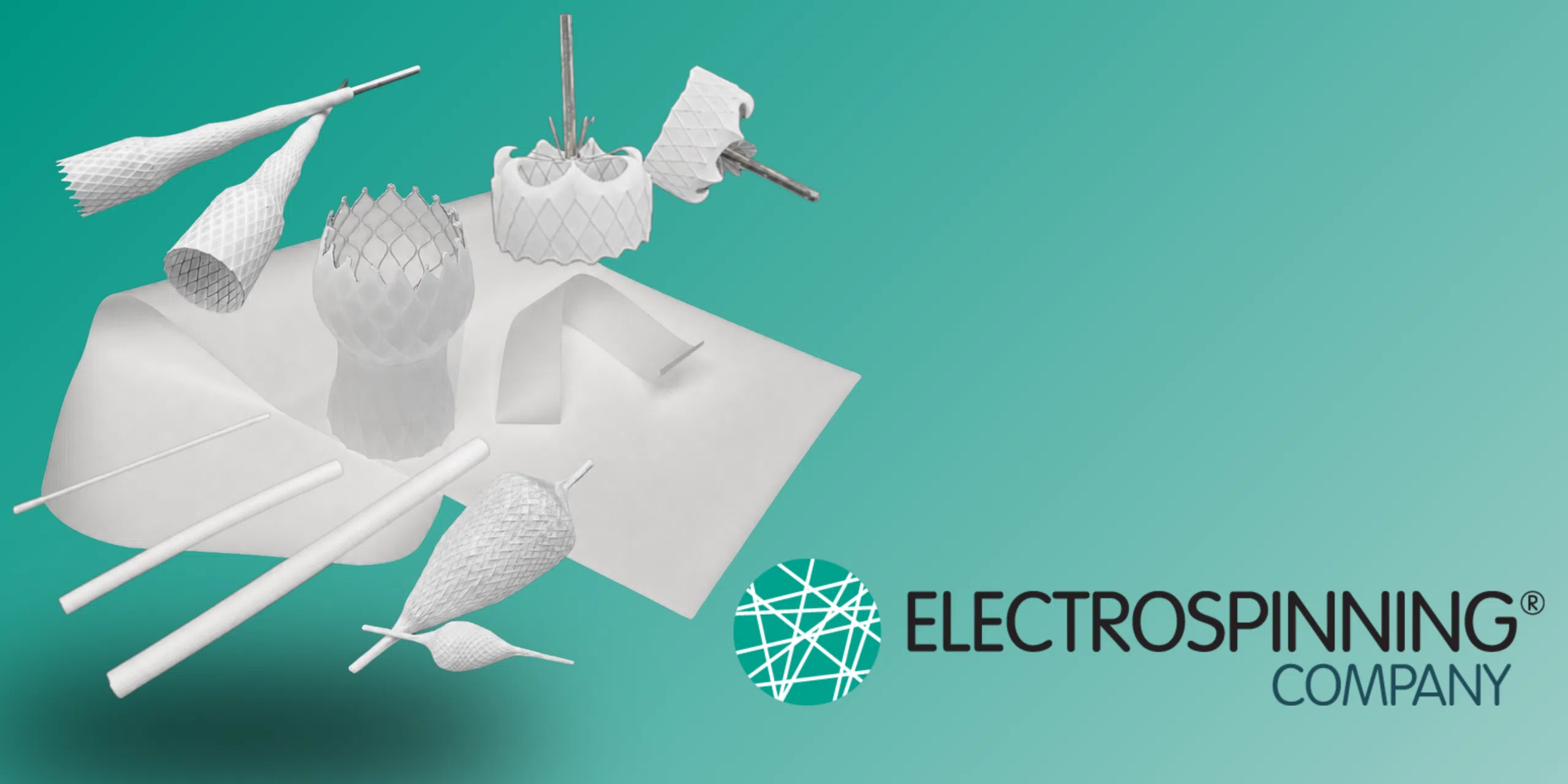
Cardiovascular device developers are under increasing pressure to reduce profile, improve conformability, and control permeability without compromising deployability or existing manufacturing routes. Hybrid electrospun-textile structures are emerging as a practical way to add functionality to established cardiovascular textiles while preserving the mechanical behaviour. At The Electrospinning Company, Caladrix® technology is used to apply thin, conformal electrospun coatings directly onto cardiovascular textile structures, enabling low-profile performance tuning for applications such as TAVI/TAVR, vascular grafts, and covered devices.
The Shift Toward Lower-Profile Cardiovascular Structures
Across cardiovascular devices, the direction of travel is clear: lower profiles, higher deployment strain, and greater functional expectations from every material layer.
This shift is being driven not only by engineering ambition, but by significant market expansion across catheter-delivered cardiovascular technologies. The global TAVI/TAVR market alone was valued at approximately USD 4.5 billion in 2024 and is projected to exceed USD 12 billion by 2033, with continued double-digit growth driven by ageing patient populations and increasing preference for minimally invasive intervention.
At the same time, vascular graft and covered stent markets continue to expand as developers push toward smaller diameter devices, lower-profile coverings, improved sealing performance, and more advanced tissue-interactive structures. The vascular graft market is projected to continue growing at around 6-7% CAGR over the coming decade, with increasing focus on minimally invasive repair and next-generation graft architectures.
In applications such as TAVI/TAVR, developers are working to reduce paravalvular leak (PVL) while maintaining flexibility and catheter deliverability. This has driven significant industry focus toward next-generation sealing skirts and low-profile covering architectures capable of improving PVL performance without negatively affecting crimping behaviour, deployment mechanics, or catheter compatibility. In vascular grafts and covered structures, teams increasingly need controlled permeability and improved tissue interaction without adding unnecessary bulk.
Importantly, many large cardiovascular OEMs are evolving existing device platforms rather than replacing them entirely. In practice, this means development teams are increasingly looking for material and coating strategies that can improve permeability control, conformability, fixation, and deployment behaviour without fundamentally changing established manufacturing routes or device architectures.
For development teams, the priority is ensuring that coating and material decisions made early in a programme generate evidence that holds up under regulatory scrutiny, transfers cleanly into manufacturing, and maintains consistent performance through scale-up and production.. Getting that architecture right from the outset is what keeps programmes on track.
The challenge is that many conventional textile modification approaches introduce trade-offs elsewhere in the system. Increasing sealing performance can affect flexibility, while secondary coating or filling processes may alter deployment behaviour or increase profile in ways that become problematic later in development.
As minimally invasive delivery becomes standard across more cardiovascular applications, material strategies that add functionality while preserving flexibility, mechanics, and manufacturability are becoming increasingly valuable.
Hybrid electrospun-textile architectures align strongly with this direction because they enable additional functionality to be integrated onto familiar cardiovascular textile structures without substantially increasing profile or introducing complex secondary assembly processes.
Why Coating Architecture Now Matters
Most cardiovascular textiles already perform well structurally. PET weaves, braids, and knitted constructions are established, scalable, and integrated into existing manufacturing workflows. The real challenge is adding functionality without disrupting the characteristics that made those textiles viable in the first place. Development teams increasingly want to:
- reduce permeability or leakage
- maintain low-profile delivery
- preserve flexibility under strain
- improve tissue interaction
- avoid complex secondary assembly steps
For many cardiovascular programmes, the coating strategy itself is now becoming a key part of overall device performance.
At The Electrospinning Company, Caladrix® technology is used as a controlled electrospun coating platform, applying thin, fibre architectures directly onto cardiovascular textile including medical-grade PET and TPU. The electrospun coating itself can also be manufactured from PET or TPU formulations, either to match the underlying substrate material or to introduce additional functional behaviour. Rather than saturating or heavily filling the textile, as is commonly seen with conventional dip-coating approaches, the electrospun layer forms a controlled interface on the surface of the substrate itself. This allows permeability and surface behaviour to be tuned while maintaining flexibility and catheter compatibility within profile-sensitive cardiovascular systems. For cardiovascular developers this creates a practical route to improve functionality while remaining compatible with existing device platforms and manufacturing workflows.
Where Hybrid Electrospun-Textile Structures Add Value
Hybrid electrospun-textile structures are attracting increasing interest because they allow developers to enhance existing cardiovascular materials while maintaining compatibility with established manufacturing routes. In practice, this can support:
- lower permeability without substantial profile increase
- maintained flexibility during catheter-based delivery
- conformal coating around complex textile geometries
- controlled interaction between the device and surrounding tissue
- functional enhancement without additional adhesive layers
This is particularly relevant in applications involving dynamic strain and cyclic loading, where coating-substrate interaction must remain stable throughout deployment and long-term use.
At The Electrospinning Company, development work around Caladrix® technology focuses heavily on coating attachment, adhesion, profile control, and preservation of the mechanics of the underlying textile structure. The objective is not simply to apply fibres onto a substrate, but to engineer a composite architecture that behaves consistently under real device conditions.
This includes development of low-profile coated textile structures engineered for controlled permeability, stable coating attachment, and consistent behaviour under mechanically demanding cardiovascular conditions. The company has also developed coated braided and woven cardiovascular structures designed to maintain conformability and coating integrity under demanding deployment and cyclic loading environments relevant to catheter-delivered systems.
From Feasibility to Manufacturable Cardiovascular Components
One of the biggest gaps in cardiovascular material development is the transition from promising concept data to manufacturable device components. Here, material performance alone is not enough. Coating consistency, substrate integration, reproducibility, and process control all become increasingly important as programmes move toward validation and scale-up.
At The Electrospinning Company we have been manufacturing components for medical devices for over a decade, with components in five FDA 510(k)-cleared devices and more than 100 feasibility projects completed across cardiovascular and biomaterials applications. This experience includes developing electrospun structures within regulated manufacturing environments where coating architecture, reproducibility, and integration behaviour must remain controlled across feasibility, scale-up, and long-term production. The company also works collaboratively with textile suppliers and development partners, including through our strategic alignment with Confluent Medical Technologies. This allows us to be flexible, enabling both retrofit coating approaches to existing materials, but also co-development of new textile structures designed specifically for electrospun integration.
Conclusion
As cardiovascular devices continue moving toward lower-profile and minimally invasive formats, coating architecture is becoming an increasingly important part of overall device performance. Hybrid electrospun-textile structures provide a route to improve permeability control, flexibility, and surface functionality while preserving the characteristics that make established cardiovascular textiles commercially viable. At The Electrospinning Company, Caladrix® technology is applied as part of a broader cardiovascular development approach focused on coating architecture, substrate integration, manufacturability, and real device performance. For teams developing next-generation cardiovascular coverings, early evaluation of coating strategy can help determine whether existing device architectures can achieve future performance requirements without compromising manufacturability, flexibility, or deployment behaviour.
FAQs
Can electrospun coatings be applied to existing cardiovascular textiles? Yes. Caladrix® technology can be applied directly onto existing textile substrates, including PET- and TPU-based cardiovascular structures.
Do electrospun coatings substantially increase device profile? Electrospun layers can provide functional enhancement while maintaining very low-profile architectures suitable for minimally invasive delivery systems.
Why are hybrid textile structures attracting attention in cardiovascular development? They allow developers to add functionality such as permeability control or tissue interaction while preserving the mechanics and manufacturability of established textile platforms.
Are hybrid electrospun-textile structures suitable for catheter-based devices? Yes. Their low-profile and conformal nature makes them particularly relevant for minimally invasive and catheter-delivered cardiovascular systems.