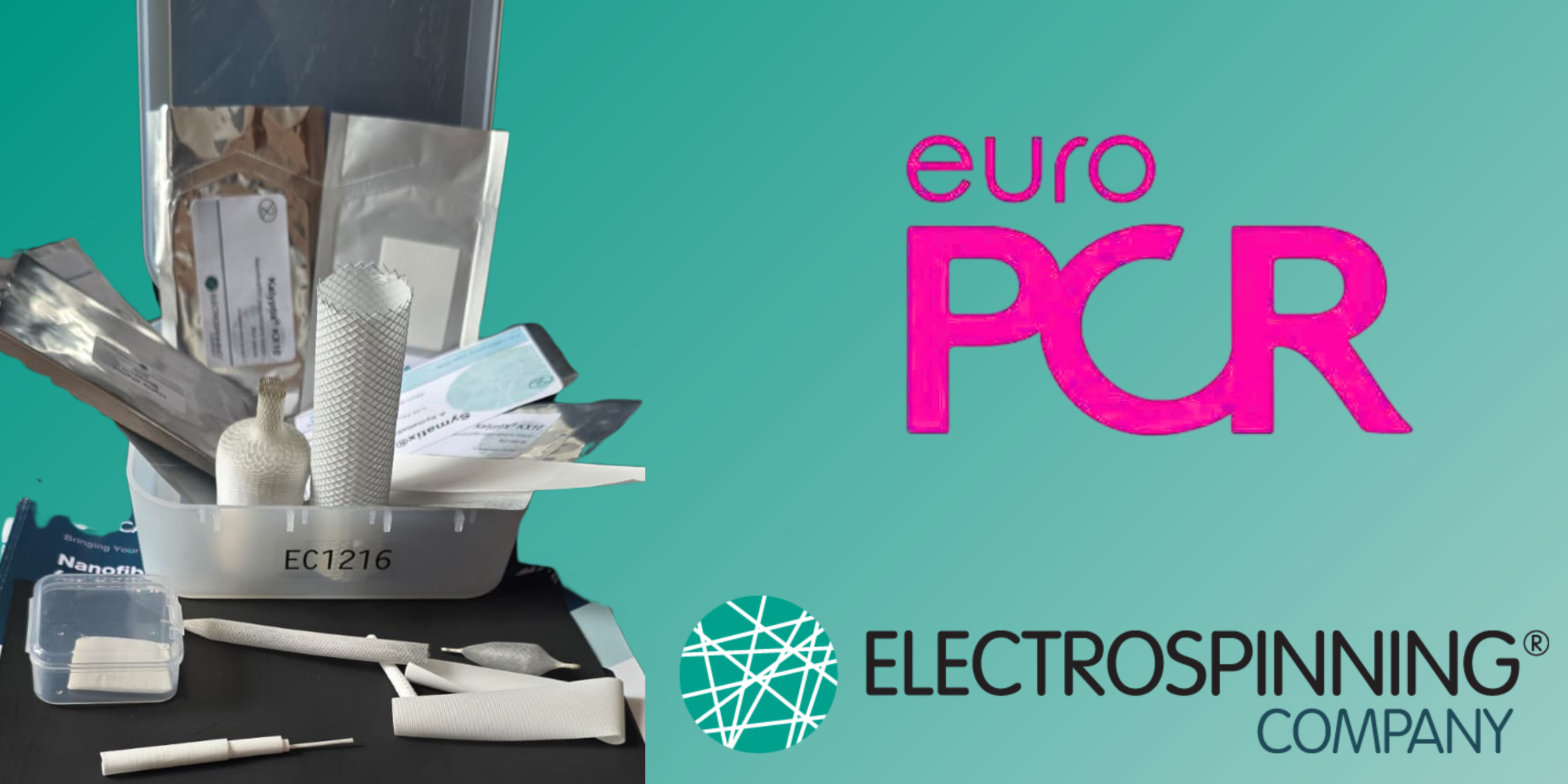
Walking the exhibition floor here at EuroPCR in Paris, the sheer scale of clinical innovation is exhilarating. MedTech giants showcase state-of-the-art AI-guided cath labs and complex imaging frameworks. But as a team representing the vanguard of electrospinning technology, we observe the conference through a completely different lens: what is unfolding at the microscopic level. Standing at the structural crossroad where material science meets interventional cardiology, our objective has been to map operator demands, evaluate market gaps, and demonstrate how structured nanofibrous engineering is turning foreign implants into platforms for healing and regeneration.
1. The Doctor’s Dilemma: What Operators are Seeking
- Ultra-Low Profiles: Physicians require structural heart components and valve leaflets that can tightly compress into low-profile micro-catheters without kinking, tearing, or warping upon deployment.
- Endogenous Tissue Restoration (ETR): There is a massive vocal push toward ‘Leave Nothing Behind’ strategies to mitigate long-term foreign-body reactions and late stent thrombosis by using devices that facilitate natural cellular integration.
- Immediate, Safe Hemostasis: With the exponential rise of large-bore sheath procedures (such as PFA, TAVI, and LAAC), managing the access site rapidly and without high-risk downstream vascular complications is a top tier clinical priority.
2. What the Industry Offers vs. The Glaring Gaps
The current commercial landscape responds with exceptional mechanical engineering, yet heavily relies on traditionally machined metals and extruded plastics. This leaves a significant compliance mismatch: standard synthetic coverings and solid polymer films are dense and uniform, causing trackability issues in tortuous vessels and triggering classic foreign-body responses rather than natural cellular infiltration.
3. Case Study: Haemonetics and the Electrospun Patch
Nothing validated our mission at EuroPCR quite like witnessing how market leaders are leveraging electrospinning to solve high-stakes clinical issues in real time. A standout highlight on the floor is Haemonetics and their expanding clinical momentum in advanced large-bore vascular closure following complex structural heart or electrophysiology procedures.
Haemonetics utilises an extravascular, bioresorbable electrospun patch to achieve rapid physiological haemostasis when extracting large-bore sheaths. This process showcases the exact dual-action advantages we evangelises:
- Instant Mechanical Tamponade: Upon deployment into the puncture tract, the highly porous nanofibrous mesh absorbs local fluid and expands immediately, perfectly contouring to and sealing the uneven geometry of the tissue pathway.
- Accelerated Physiological Clotting: Because the electrospinning process fabricates an architecture that mimics the native extracellular matrix (ECM) down to the nanometer scale, endogenous platelets and clotting factors recognize the patch as native tissue, drastically accelerating the natural coagulation cascade.
EuroPCR Registry Data Insight: Clinical outcomes highlight rapid times-to-ambulation, minimised bed rest, and an exceptional safety profile with zero major access-site complications. It proves that when you provide the body with a scaffold that speaks its own structural language, it heals beautifully.
4. Expanding Capabilities: Spinning with Advanced Bioactive Hemostatics
To further close the access-site gap, the frontier of electrospinning has moved beyond pure synthetics into bioactive co-spinning. By directly introducing naturally thrombogenic biomaterials into the electrospinning polymer solution, we can manufacture patches and device coverings with inherent, hyper-accelerated clotting capabilities:
- Collagen Blending: Spinning structural synthetic polymers (like PCL) directly with highly purified collagen preserves structural elasticity while displaying dense clusters of native cell-binding sites. This triggers instant, receptor-mediated platelet activation directly on the surface of the mesh.
- Chitosan Integration: Integrating chitosan—a positively charged biopolymer—into the electrospun nanofiber matrix introduces a powerful charge-based mechanism. The positive charge of the chitosan fibers electrostatically attracts negatively charged red blood cell membranes, generating a robust physical ‘mucoadhesive’ plug independent of the body’s natural clotting cascade. This is highly effective even in heparinized or anti-coagulated patients.
5. How Electrospinning Closes the Core Structural Gaps
- Overcoming Tortuous Anatomies via Anti-Kinking Matrix Architecture
By combining solution electrospinning with structural reinforcement (such as 3D-printed micro-skeletons or metallic frames), we engineer composite medical device covers. These micro-porous coverings allow a structural valve frame or graft to bend and loop through highly calcified vascular paths without crimping or compromising internal lumen diameter.
- Micro-Porosity for True Endogenous Tissue Restoration (ETR)
Solid extruded plastics and films typically trigger dense fibrotic encapsulation. Our electrospun matrices feature highly controlled, interconnected porosity. When implanted, host cells migrate into the structure. Over a 12-to-24-month horizon, the matrix predictably is fully encapsulated or degrades while the patient’s own body replaces it with living, functional tissue. - Low profile for easy delivery in minimally invasive surgery
By depositing nano-fibres directly onto metallic or polymeric frames, it is possible to create highly uniform porous coverings with coating thicknesses below 10 microns, depending on the material system, process parameters, and device geometry. These ultra-thin coatings can preserve the mechanical behaviour of the underlying frame while adding a functional biological interface and minimising blood leakage.
The Horizon Ahead
Leaving EuroPCR, the consensus is clear: the next generation of cardiovascular intervention belongs to adaptive, biomimetic materials that mirror human biology at the micro-scale and can be delivered to surgical site easily without trauma. Through precision electrospinning, we aren’t just manufacturing components; we are weaving the exact structural frameworks that empower surgeons and promote healing.
Read more about Caladrix® technology and how electrospun coating architectures are supporting next-generation implantable device development.