Endovascular | Case Study
Services / Case Studies / Endovascular
Endovascular | Case Study
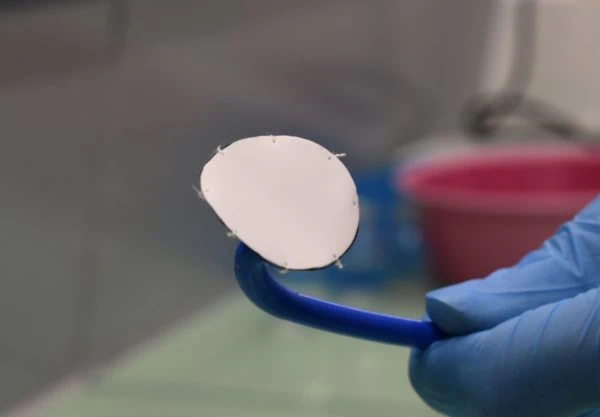
Aortyx needed a catheter-deliverable patch that could survive deployment, adhere under arterial pressure, and scale toward regulated manufacturing not just work in the lab. Using Mimetix® technology, The Electrospinning Company helped translate an electrospun material concept into a functional, repeatable device component with a clearer path toward validation, clinical development and future manufacture.
Aortyx is a pioneering medical technology company founded by researchers from the IQS School of Engineering and the Hospital Clinic de Barcelona. They are dedicated to developing a new generation of endovascular devices to treat complex vascular diseases, specifically targeting Aortic Dissection.
Aortic Dissection
Aortic Dissection is a life-threatening condition where the inner layer of the aorta tears, creating a “false lumen.” This condition carries high mortality rates if untreated and presents significant clinical and economic burden on healthcare systems, making effective, minimally invasive solutions a major unmet need in cardiovascular care. Traditional treatments, highly invasive open surgery or standard endovascular grafts, often face limitations in anatomical compatibility and long-term biological integration.
Aortyx envisioned a bioresorbable patch with an adhesive that could be delivered via catheter to “patch ” the tear. However, creating a material that is thin enough for delivery, strong and flexible enough to survive in the aorta, and capable of integrating with specialised adhesives required a sophisticated technology platform. Crucially, many promising concepts in this space fail at the point of translation, where a material decision must survive catheter delivery, maintain integrity under arterial pressure, integrate with adhesive systems, meet validation requirements and support a future manufacturing pathway simultaneously. Bridging this gap between concept and clinically viable product remains a major bottleneck in cardiovascular device development.
Challenges
Aortyx needed a catheter-deliverable patch that could survive deployment, adhere under arterial pressure, and scale toward regulated manufacturing not just work in the lab. Using Mimetix® technology, The Electrospinning Company helped translate an electrospun material concept into a functional, repeatable device component with a clearer path toward validation, clinical development and future manufacture.
Solutions
To address this challenge, The Electrospinning Company worked with Aortyx to define what the material needed to prove in the device environment, then used the proprietary Mimetix® technology platform to design a material system capable of meeting both performance and manufacturing requirements.
Electrospinning enabled a level of control over fibre diameter, porosity, and architecture that is difficult to achieve with conventional film casting or textile approaches. This allowed the creation of a highly porous yet mechanically robust structure that balances flexibility, strength, and low profile, critical for catheter-based delivery. In addition, the ability to tailor fibre alignment and layer structure supported rapid design iteration and optimisation, accelerating development timelines.
This level of control was essential to de-risk the design early, enabling a solution that could meet both functional performance and manufacturability requirements, something difficult to achieve with conventional materials.
Precision Engineering of Fiber Architecture
Using the Mimetix® platform, we optimized the internal morphology and architecture of the patch. The functionality of the device is dictated by several critical parameters we fine-tuned:
- Fiber Morphology & Diameter: Controlled to mimic the extracellular matrix, facilitating cellular infiltration.
- Layer Thickness: Optimized for a low-profile delivery while maintaining structural integrity.
- Mechanical Performance & Recovery: Engineered so the patch reliably recovers its intended shape and mechanical properties immediately after deployment from a high-strain catheter system.
- Suture Retention: Providing the necessary strength for secure fixation on delivery system without compromising the material’s integrity.
Critical Interaction: Adhesive Integration
A unique requirement for this device is its interaction with a specialised adhesive. The patch must act as a perfect substrate to stick to the wall of the aorta. We engineered the surface properties and porosity of the Mimetix® patch to ensure optimal adhesive interface, allowing the patch to stay securely in place against the high-pressure blood flow of the aorta while the vessel heals.
Importantly, the electrospun structure provided a tuneable surface energy and interconnected porosity that enhanced adhesive penetration and bonding, supporting reliable fixation under dynamic physiological conditions.
Advanced Manufacturing & Materials
The platform includes deep expertise in the spinning and post-processing of degradable polyesters. This post-processing is vital to enhance both the biological functionality and the industrial manufacturability of the material. All development was carried out under our ISO 13485 quality management system, ensuring traceability, process control, and a clear pathway from early prototypes to clinical-grade manufacturing.
The Electrospinning Company’s role went beyond material development – we enabled the transition from concept to a development-ready, manufacturable solution. By scaling electrospinning processes, improving batch-to-batch consistency, and defining critical quality attributes, The Electrospinning Company helped generate decision-grade evidence for later-stage development. This reduced the risk of failure at validation and manufacturing stages and ensured the material was not only functional, but reproducible, scalable, and aligned with regulatory expectations.
Result
The collaboration has successfully translated Aortyx’s research into a high-performance medical device. By leveraging the Mimetix® platform, we significantly shortened production timelines and improved process consistency. This reduced development risk and created a more predictable pathway toward regulatory approval and future commercialisation.
Testimonial

“The Electrospinning Company and Aortyx R&D teams have been collaborating for years. This professional interaction has led to a common understanding of the Mimetix® technical platform which he have been able to leverage to manufacture a consistent endovascular patch now ready for the next stage of clinical development.”